Case study · Precision Fire Protection
They asked for a form. They needed a calendar.
Precision Fire Protection wanted to stop living on repair work and build a business on inspections instead — the part of the trade that is mandated, scheduled, and comes back whether anyone sells it again. What they first asked me to build was a digital version of their inspection form. What it became is the system that books next year's work while this year's is still being filed.
- Client
- Precision Fire Protection
- Built
- Aimpoint Inspector, running since 2015
- Shape
- Field inspection → scheduling → billing
The situation
Repairs are luck. Inspections are a calendar.
A fire protection company that lives on repairs is waiting for something to fail. The work is real and it pays, but it arrives when it arrives, and no amount of selling makes a sprinkler system break in a quarter where the numbers are short.
Inspections are the opposite. NFPA 25 does not ask a building owner for an inspection. It asks for a cycle — quarterly, semi-annual, annual, and for some systems a third-year and a five-year test on top. A building with a wet sprinkler system, a standpipe and a fire pump owes a contractor work several times a year, every year, for as long as the building stands.
Precision could see that. The problem was that their inspections lived on paper, and paper has no memory. A clipboard tells you what happened today. It cannot tell you that Riverbend Senior Living is due again in February.
What was asked for
We started with the form.
The brief
Put the inspection form on a tablet so an inspector stops filling it in by hand, driving back, and handing it to someone who types the whole thing up a second time.
What that exposed
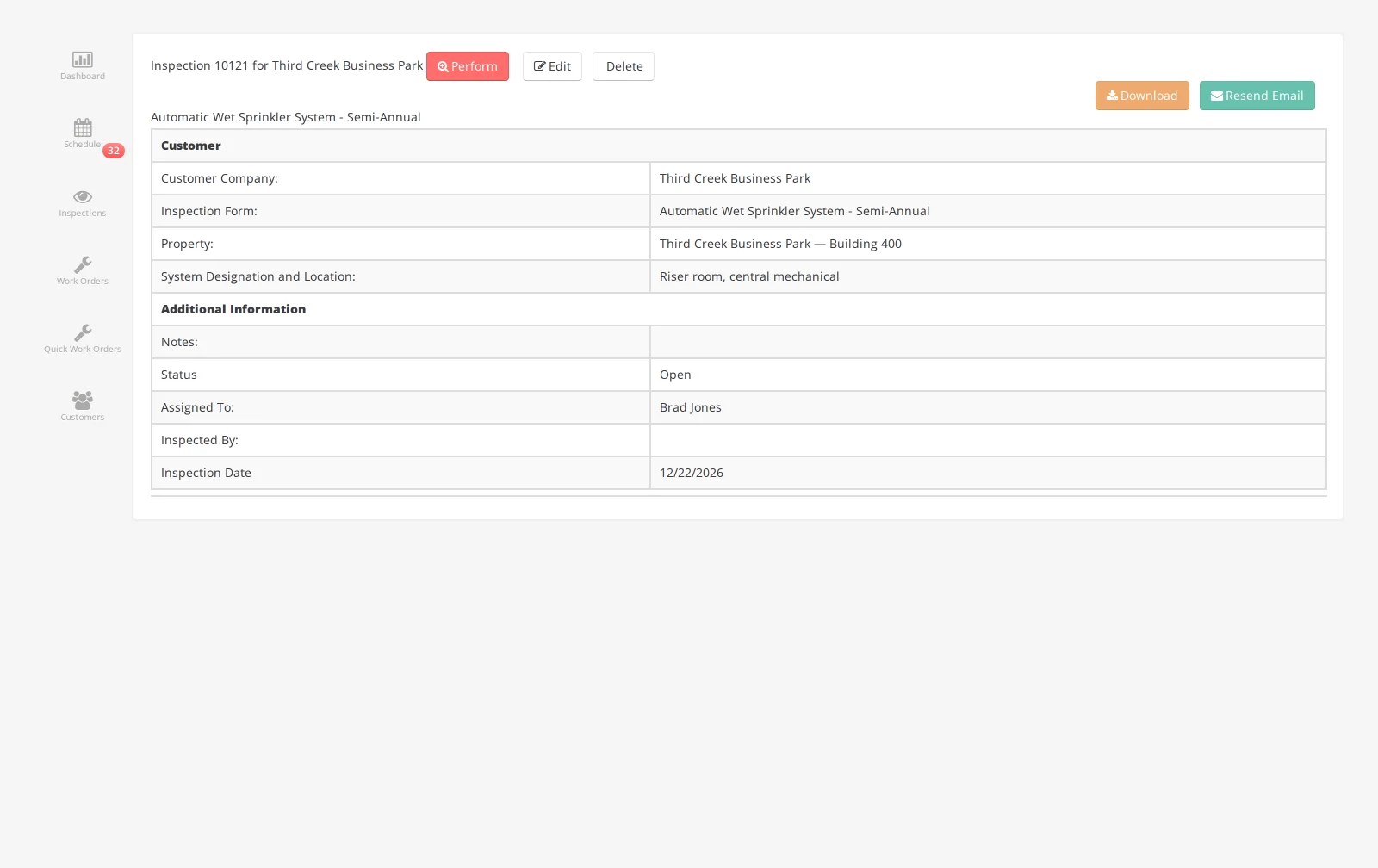
Once the form was digital, every question after it was about the record rather than the paperwork. Which building was this? Which system in it? Who is assigned? When is it due again? A form answers none of those, and all of them are the business.
Where it went
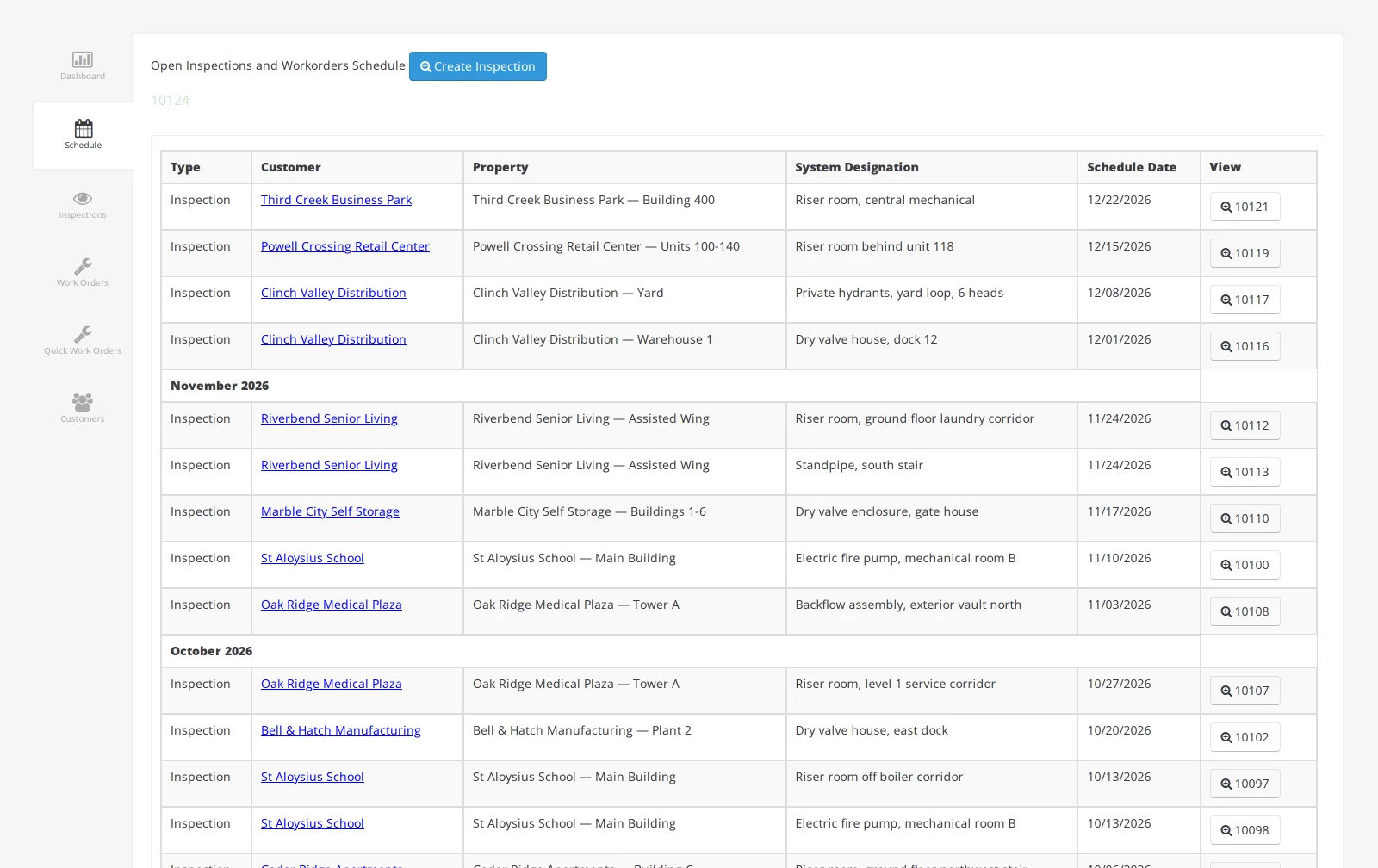
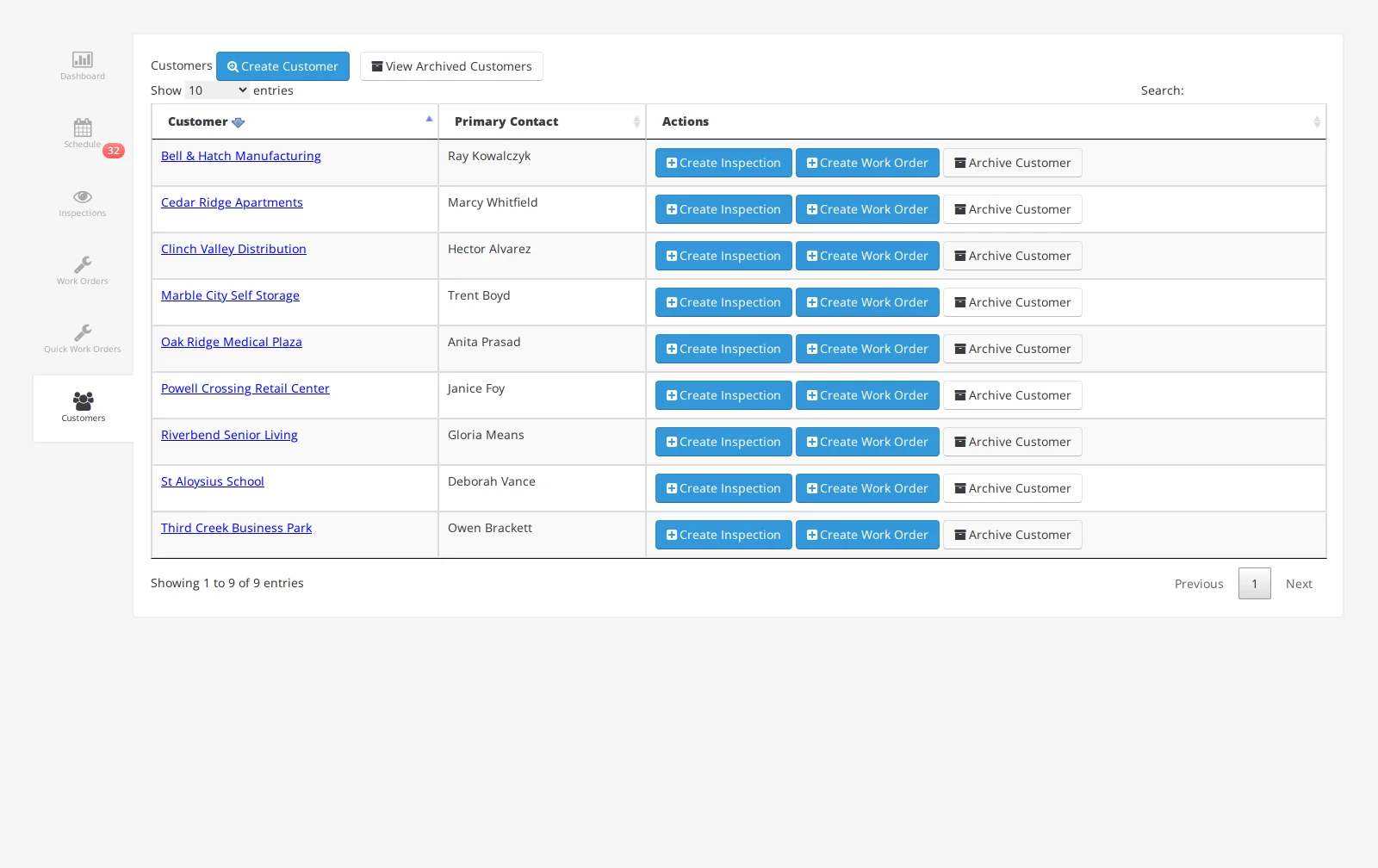
The form became a record, the record grew a customer and a property, the property grew a schedule, and the schedule is the thing that turns one finished inspection into the next one already on the books.
The hinge
Every form in it is a frequency.
This is the decision the whole system rests on. The inspection library is not a list of documents, it is a list of obligations, and each one carries its interval in its name:
- Automatic Wet Sprinkler Q / SA / A
- Automatic Dry Sprinkler Q / SA / A
- Fire Pump Assemblies Q / SA / A
- Standpipe & Hose Q / SA / A / 3yr
- Preaction & Deluge Q / SA / A / 3yr
- Dry System Air Leakage 3yr
- Internal Obstruction Investigation
- Backflow, Hydrants, Pump Test Annual
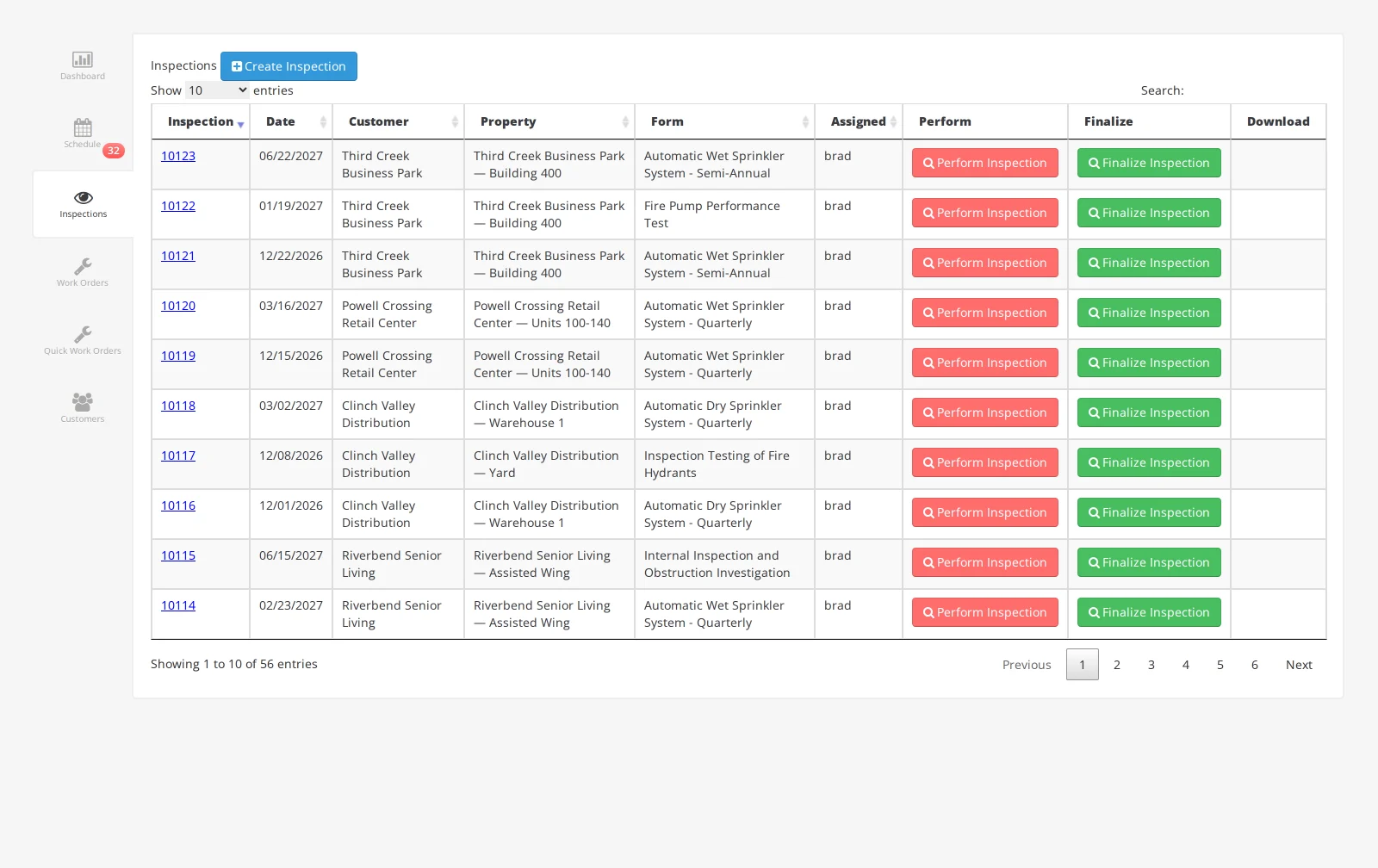
Twenty-three forms, and there is no such thing as a one-off among them. When an inspector picks “Automatic Wet Sprinkler System – Quarterly”, the business has not recorded a job. It has recorded the first instance of something that happens four times a year, at a named property, for a named customer, forever.
Nobody has to remember to sell the next one. That is the entire difference between billing for inspections and running on them.
The system
What the office actually looks at.
The part people miss
The repair work did not go away. It stopped being the plan.
Work orders are still in the system, and they still pay. What changed is where they come from. An inspector standing in front of a riser writes up a deficiency, and that becomes a work order against a customer who is already on the books — not a phone call that had to arrive on its own.
So the recurring work is the floor, and it feeds the lumpy work on top of it. That is the right way round, and it is the outcome Precision was after when they described the idea as a subscription rather than a product.
Since
It has been running since 2015.
That is the only claim on this page I would ask anyone to weigh, and it is the one that matters. Plenty of software gets built. Software that a working trade is still filing real inspections through a decade later is a different thing, and it is not the sort of outcome that can be arranged after the fact.
It started as a form, because that is what the customer asked for and that is the honest place to start. It is worth saying plainly that nobody drew this system up front. It was reached one answered question at a time, which is how most software that survives gets built.
If the job you keep doing by hand is really a cycle, say so.
Most businesses have one. It looks like a form, a checklist or a spreadsheet, and the thing it is actually hiding is a schedule nobody is being paid to keep.
Book a call with me